What to Do When You Find a Baby Deer
I Found a Baby Deer/Bird/etc., What Should I Practise?
Yous're walking forth, enjoying the sights and sounds of nature, when you glance down and spot a young deer lying down in some bushes! The fawn is utterly alone with no mother in sight, and you're agape the poor thing has been abandoned. What do you practice?
When they run into the fawn by itself, many people assume the mother has left it for practiced, and their first instinct is often to "rescue" the fawn. Withal, if the fawn is not apparently sick or injured, the all-time grade of activeness is to get out it be. In the first month after nascency, a doe spends most of her fourth dimension resting or foraging 50 yards to a mile away from her fawn (White et al. 1972). She may return merely a few times each day to groom or feed it, until the fawn becomes active enough to spend more time with her (Piccolo et al. 2010). While it may seem odd for the doe to devious so far, the fawn is perfectly adapted to stay safe until its mother comes back. Its white spots function as cover-up, and its freezing behavior (staying utterly still, oft with the head down or tucked abroad) helps it remain hidden. To avert leading predators to her fawn, the mother will not render until she believes the expanse is clear of danger — which includes you! For that reason, leaving the fawn alone and keeping pets out of the vicinity is essential. Furthermore, similar with many wild fauna, possessing a fawn is illegal and could get you in trouble with the constabulary (Webb 2010).

While non always as predictable as the doe leaving the fawn to forage, apparent separation of young animals from their parents occurs commonly throughout nature. In most cases, the parents are well equipped to handle the situation. For instance, if you observe a baby bird on the ground, there's a high chance the parents are nearby. According to the Audubon Society of Portland, many species of birds leave the nest before they are able to fly and spend up to 5 days on the ground as fledglings. During this fourth dimension, the parents go on protecting and caring for them. The best thing yous can practice to help a fledgling on the footing is to proceed pets abroad — placing information technology back in the nest is often pointless because the fledgling will jump out once again. If the baby bird lacks all or almost of its feathers and appears to have fallen from the nest as well early, you tin can put it back in the nest (if the nest is destroyed, placing the bird in a basket and hanging it from a high limb volition make it easily bachelor to the parents). Birds take stiff protective instincts and a study by Ortega et al. (1997) shows that handling eggs and chicks does non cause American robins to abandon their nests. While the sensitivity to human presence or disturbance likely varies by species, Ortega et al. (1997) advise birds in urban areas are frequently exposed to humans and may have a higher tolerance of man activeness and handling as a result. However, the parents will still be hesitant to return to the nest while humans are all the same nearby, and then be certain to keep your distance afterwards returning the chick to the nest. Although it may be tempting to accept the babe bird dwelling house to care for information technology, call up that the chick is better off being raised past its real parents, and according to the The states Fish & Wildlife Service, information technology is illegal to possess a wild bird (Migratory Bird Treaty Act 2015).
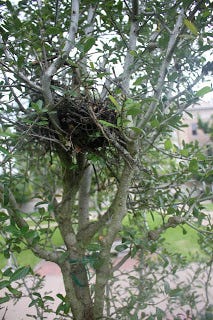
Just like the fawn and fledgling birds, many wildlife babies that at first glance appear to be abandoned are not actually in need of rescuing. In fact, taking immature animals out of the wild — even with the best of intentions — often results in more harm than good (and may even be against the law!). Animals raised in captivity are usually unable to larn necessary survival skills taught past their parents and therefore cannot survive in the wild. No matter how difficult information technology may exist to walk abroad from a seemingly helpless fawn or bird, the about beneficial do to the animal is to leave information technology solitary and allow the parents to practise their job.
Literature Cited
- Migratory Bird Treaty Deed. 2015. U.Southward. Fish & Wildlife Service. <http://www.fws.gov/birds/policies-and-regulations/laws-legislations/migratory-bird-treaty-human activity.php>. Accessed 2 June 2015.
- Ortega, C. P., J. C. Ortega, C. A. Rapp, Southward. Vorisek, S. A. Backsento, and D. W. Palmer. 1997. Effect of Research Activity on the Success of American Robin Nests. Journal of Wildlife Direction 61(three): 948–952.
- Piccolo, B.P, T.R. Van Deelen, Yard.Hollis-Etter, D.R. Etter, R.East. Warner, and C. Ballast. 2010. Behavior And Survival Of White-Tailed Deer Neonates In Two Suburban Wood Preserves. Canadian Periodical of Zoology 88(5): 487–495.
- Webb, A. 2010. Pineywoods Post. Texas Parks and Wild animals Department.
- White, M., F. F. Knowlton, W. C. Glazener. 1972. Effects of Dam-Newborn Fawn Behavior on Capture and Mortality. Journal of Wild fauna Management 36(3): 897–906.
- What To Exercise If You Find A Baby Bird. Audubon Guild of Portland. <http://audubonportland.org/wcc/urban/babybirds>. Accessed 28 May 2015.
armstrongparm1936.blogspot.com
Source: https://medium.com/wild-wonderings/i-found-a-baby-deer-bird-etc-what-should-i-do-ec635fb36f10
0 Response to "What to Do When You Find a Baby Deer"
Post a Comment